
 Spanish
 English
In the plant world, growing does not necessarily mean reaching maturity. And maturity does not mean that a plant is...
Search in blog
Latest posts

Plants grow, change and age, but when do they actually reach maturity?
Read more
Why Do Plants Change Colour? The Story Behind Their Leaves
Read more
Have you ever watched a green leaf turn yellow, reddish or purple and wondered what is happening inside the plant?...

Young People and Drugs in Europe: When Curiosity Meets the Internet
Read more
Talking about drug use among young people does not simply mean talking about statistics. It also means talking about...

São Paulo Becomes the Green Capital of August and Europe Has Plenty to Discover
Read more
Every year, certain cities become the center of attention for an entire community. In August, that city is São Paulo....

Originality that protects the essential and tells a story in every seed.
Read more
In a market where every detail matters, the difference doesn't always lie in the obvious. In the world of...
Featured posts
Plants grow, change and age, but when do they actually reach maturity?
In the plant world, growing does not necessarily mean reaching maturity. And maturity does not mean that a plant is...
Read more
Why Do Plants Change Colour? The Story Behind Their Leaves
Have you ever watched a green leaf turn yellow, reddish or purple and wondered what is happening inside the plant?...
Read more
Young People and Drugs in Europe: When Curiosity Meets the Internet
Talking about drug use among young people does not simply mean talking about statistics. It also means talking about...
Read more
São Paulo Becomes the Green Capital of August and Europe Has Plenty to Discover
Every year, certain cities become the center of attention for an entire community. In August, that city is São Paulo....
Read more
Originality that protects the essential and tells a story in every seed.
In a market where every detail matters, the difference doesn't always lie in the obvious. In the world of...
Read more
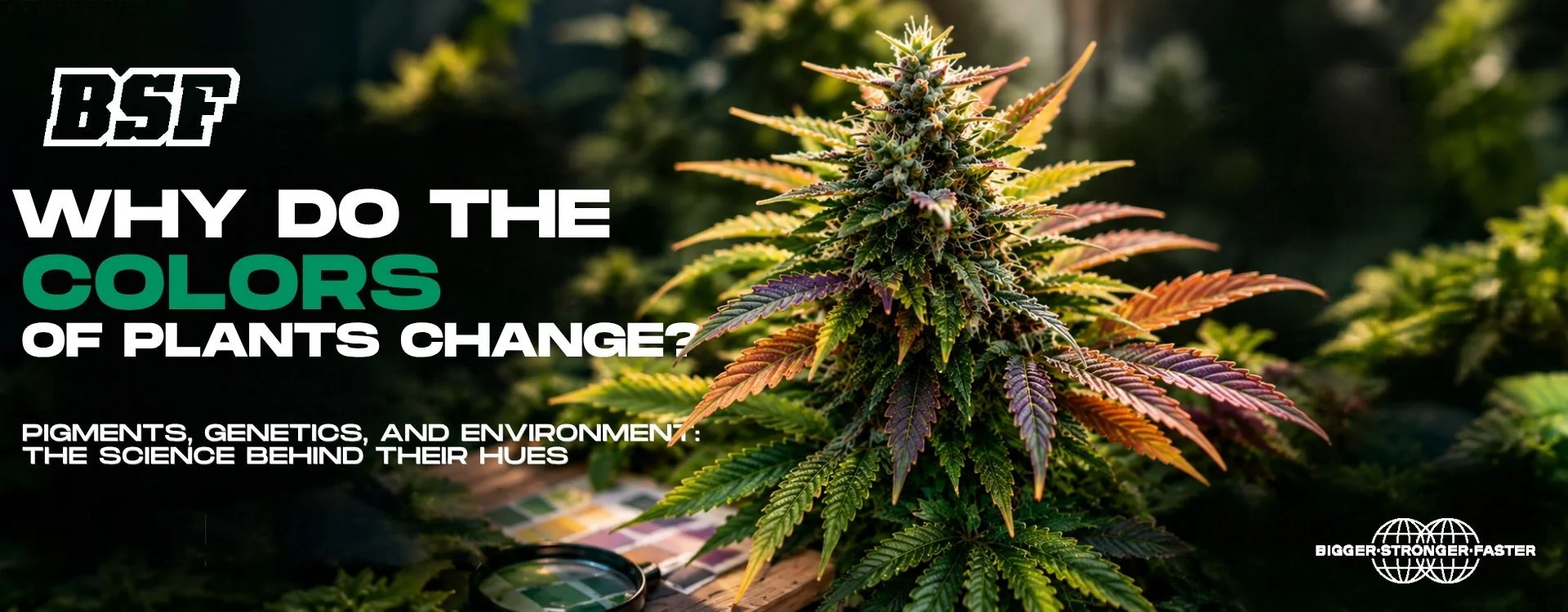
Why Do Plants Change Colour? The Story Behind Their Leaves
Why Do Plants Change Colour? The Story Behind Their Leaves
Plants Have Their Own Colour Palette
Have you ever watched a green leaf turn yellow, reddish or purple and wondered what is happening inside the plant?
Plant colours are much more than decorative details. Behind them are pigments, biological processes, genetic traits and responses to the environment. Understanding why plants change colour helps us observe them more carefully and distinguish natural processes from possible signs of stress.
In the world of plant genetics, including the European cannabis seed market, colour is also a major talking point in variety photographs, catalogues and collections. However, there is an important difference between observing a visual characteristic and understanding a plant’s actual condition.
To make sense of these changes, we first need to meet the main characters behind the colours: plant pigments.
The Plant Pigments Behind Leaf Colours
Chlorophyll, the Green That Sustains Life
Chlorophyll is the pigment responsible for much of the green colour in plants. It plays a vital role in photosynthesis, the process through which plants use light energy to produce organic compounds.
When chlorophyll levels decrease, other pigments already present in the tissue may become more visible. This is why a leaf losing its green colour can begin to display yellow, orange or other shades.
But here is the important part: a yellow leaf does not have just one possible explanation. It may be related to natural ageing, environmental conditions, nutrient availability or different types of stress. Colour alone cannot identify the cause.
Carotenoids, Nature’s Yellows and Oranges
Carotenoids are pigments responsible for yellow and orange shades. Besides contributing to the appearance of leaves, flowers and fruits, they play important roles in photosynthesis and in protecting plants from excess light energy.
A familiar example is the colour change seen in the leaves of certain trees during autumn. As chlorophyll breaks down in deciduous species, carotenoids can become more visible.
The transformation may seem sudden, but it reflects biological processes that develop over time.
Anthocyanins, the Reds, Purples and Blues
Anthocyanins are pigments associated with red, purple, violet and bluish tones. Their expression depends on several factors, including genetics, plant tissue and environmental conditions.
That is why some plants develop intense colours without those colours necessarily indicating a problem.
In certain varieties, genetic characteristics favour particular pigmentation patterns. Light, temperature and other environmental factors can influence how these colours appear, although the results are not always the same.
Plant Development, Maturity and Ageing Are Not the Same
These three terms are often used as if they meant the same thing, but they describe different processes.
Plant development: This includes the changes a plant undergoes throughout its life cycle, from germination to the formation of new tissues and structures. Leaf growth, branching and organ differentiation are all part of development.
Maturity: This refers to the degree of development reached by a plant or a particular organ in relation to a specific function or stage. A leaf can reach functional maturity while the plant continues to develop.
Plant ageing: Also known as senescence, this is a regulated biological process during which certain cells, tissues or organs gradually lose activity. In leaves, it can involve chlorophyll breakdown and the redistribution of nutrients to other parts of the plant.
These processes can be connected, but they are not interchangeable. A plant may continue growing while some of its leaves age, and a change in colour does not, by itself, prove that the entire plant has reached a particular stage.
Understanding this distinction is especially useful when observing photographs of different varieties or comparing plants grown in different environments.
Why Do Two Plants Have Different Colours?
Genetics is one of the first factors to consider. Not all plants produce or express pigments in the same way.
Environmental conditions also play a role, including light intensity, temperature, water availability and nutrition. Their effects depend on the species, variety and specific growing conditions.
For example, plants of the same species may display different colours when grown indoors or outdoors. The indoor vs outdoor growing comparison is particularly interesting in Europe, where light, temperature and humidity can vary significantly between growing environments and regions.
This does not mean outdoor conditions always produce more colour or that indoor environments guarantee uniform shades. Each setting combines variables that interact with one another.
If irregular yellowing, spots, dead tissue or deformations appear, it is important to consider the full range of symptoms and the surrounding conditions. Visual changes can have many different causes, so diagnoses should not rely on a photograph alone.
What Plant Photography Shows — and What It Doesn't
Images are excellent tools for learning to recognise pigments and colour variations. However, they can also lead to misleading conclusions.
Lighting, white balance, saturation, digital editing and the screen used to view an image can significantly affect perceived colours.
A plant with intense purple tones may look spectacular in a photograph, but that image does not prove it has better quality, greater potency, higher THC levels or better plant health than a green specimen.
The same applies to cannabis seed catalogues in Europe. Photographs can illustrate the appearance a variety may display, but they cannot guarantee that every individual plant will look exactly the same.
At BSF Seeds, as in any project involving plant genetics, it is useful to separate visual characteristics from other attributes that require specific information or independent evaluation.
An attractive image is a visual reference, not a laboratory analysis.
Genetics Is Also Part of the Colour Story
People researching feminised seeds, autoflowering seeds or photoperiod seeds often come across photographs of plants with very different structures and colours.
These categories describe different seed and plant characteristics. They do not, on their own, predict a particular colour.
The same applies to terms such as Fast Version or Californian genetics. A genetic line's name does not replace specific information about pigmentation, nor does it guarantee that a variety will display certain colours under every condition.
When comparing varieties, it is worth reviewing reliable descriptions, documented genetic characteristics and photographs that accurately represent the specimens.
At BSF Seeds, we believe understanding genetics also means learning to interpret what we see without confusing an eye-catching feature with a guarantee of performance or quality.
FAQs About Plant Colours
Why do plant leaves change from green to yellow?
This can happen when chlorophyll levels decrease, allowing other pigments to become more visible. Natural ageing is one possible cause, but environmental stress, nutrition and other factors may also contribute. Colour alone cannot provide a diagnosis.
Which pigments produce plant colours?
Chlorophyll produces much of the green colour, carotenoids contribute yellow and orange shades, and anthocyanins can create red, purple and bluish tones.
Why do some plants have purple leaves?
Purple colouring may result from the presence and expression of anthocyanins, influenced by genetics and environmental conditions. Purple leaves do not automatically indicate better health, greater potency or superior quality.
Does a change in colour mean a plant is unhealthy?
Not necessarily. It may be part of natural ageing or reflect genetic and environmental characteristics. To understand an unusual change, it is important to consider its distribution, progression and any other symptoms.
Does a plant’s colour prove its quality?
No. Colour is a visual characteristic that must be considered alongside other information. A photograph cannot independently confirm quality, potency, chemical composition or plant health.
Why do photographs of the same variety show different colours?
Differences may result from the genetics of individual plants, environmental conditions, lighting, white balance and digital editing. This is why two photographs are not always directly comparable.
Look Beyond the Colour
Every plant colour tells a story, but understanding it requires more than looking at a leaf. Pigments, genetics, development and environmental conditions combine to create an extraordinary range of visual characteristics.
The next time you see a yellow, red or purple plant, remember that colour is a clue, not a definitive answer.
Interested in learning more about plant genetics and the characteristics of different varieties? Explore the educational content from BSF Seeds Europe and discover the science behind every genetic line.
Related posts
 The Big Bang of Your Grow — Unlock Your Seeds' Potential with BSF SEEDS
Welcome to the space where the passion for cannabis comes to life. We share knowledge, practical tips and the latest...
Read more
Vegetative Stage in Mediterranean Climates: The Secret to an Explosive Grow
Vegetative Stage in Mediterranean Climates: The Secret to an Explosive Grow
The Mediterranean climate has a special...
Read more
Preflowering in cannabis: the moment when your plant reveals what’s coming next
The preflowering stage, also known as the transition to reproductive growth, is that moment when the cannabis plant...
Read more
The Stage Everyone Awaits: Cannabis Flowering in Europe
When a cannabis plant enters the flowering stage, everything changes. Cultivation stops being a simple routine and...
Read more
Cannabis root flushing: the final touch that defines your harvest
Root flushing is one of the most subtle yet decisive stages in cannabis cultivation. There is no visible growth or...
Read more