
 Spanish
 English
In the plant world, growing does not necessarily mean reaching maturity. And maturity does not mean that a plant is...
Search in blog
Latest posts

Plants grow, change and age, but when do they actually reach maturity?
Read more
Why Do Plants Change Colour? The Story Behind Their Leaves
Read more
Have you ever watched a green leaf turn yellow, reddish or purple and wondered what is happening inside the plant?...

Young People and Drugs in Europe: When Curiosity Meets the Internet
Read more
Talking about drug use among young people does not simply mean talking about statistics. It also means talking about...

São Paulo Becomes the Green Capital of August and Europe Has Plenty to Discover
Read more
Every year, certain cities become the center of attention for an entire community. In August, that city is São Paulo....

Originality that protects the essential and tells a story in every seed.
Read more
In a market where every detail matters, the difference doesn't always lie in the obvious. In the world of...
Featured posts
Plants grow, change and age, but when do they actually reach maturity?
In the plant world, growing does not necessarily mean reaching maturity. And maturity does not mean that a plant is...
Read more
Why Do Plants Change Colour? The Story Behind Their Leaves
Have you ever watched a green leaf turn yellow, reddish or purple and wondered what is happening inside the plant?...
Read more
Young People and Drugs in Europe: When Curiosity Meets the Internet
Talking about drug use among young people does not simply mean talking about statistics. It also means talking about...
Read more
São Paulo Becomes the Green Capital of August and Europe Has Plenty to Discover
Every year, certain cities become the center of attention for an entire community. In August, that city is São Paulo....
Read more
Originality that protects the essential and tells a story in every seed.
In a market where every detail matters, the difference doesn't always lie in the obvious. In the world of...
Read more
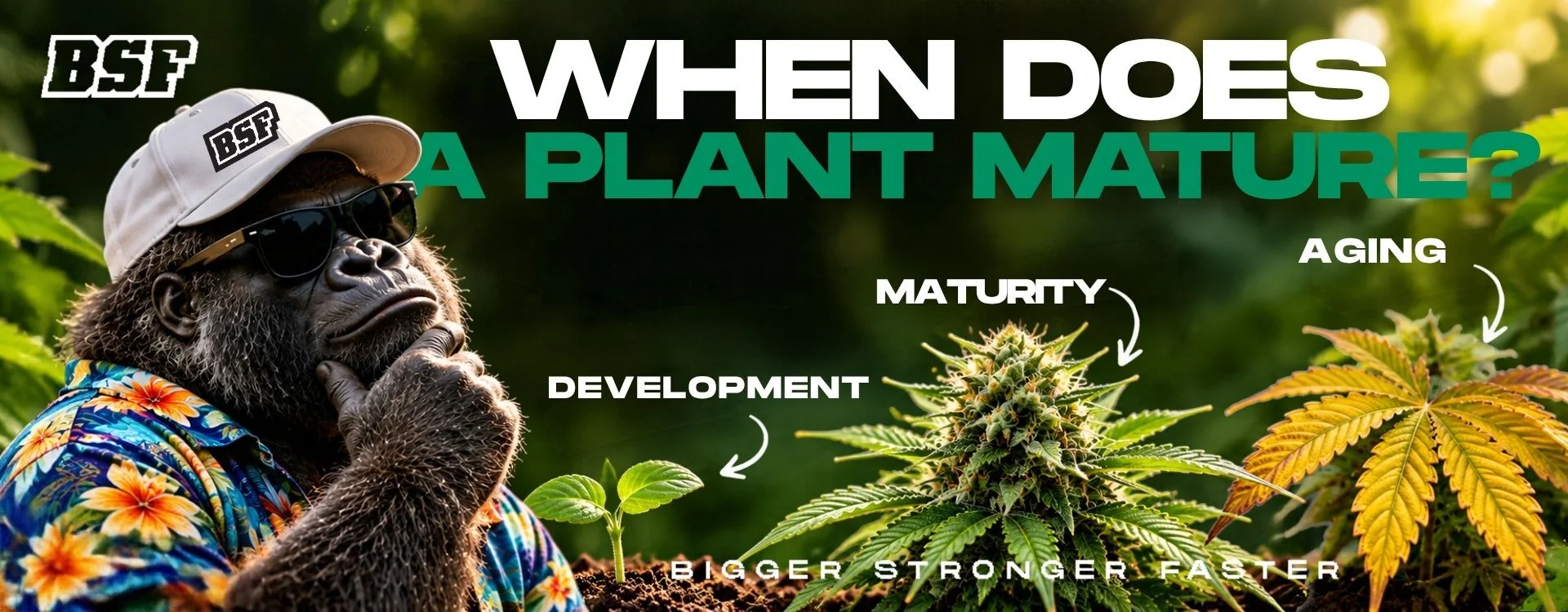
Plants grow, change and age, but when do they actually reach maturity?
When Does a Plant Reach Maturity? Three Botanical Concepts That Mean Different Things
Plants grow, change and age, but when do they actually reach maturity?
In the plant world, growing does not necessarily mean reaching maturity. And maturity does not mean that a plant is ageing either. Although these words are often used interchangeably in everyday conversation, in botany they describe different processes.
A plant can develop new leaves while others reach functional maturity. It can even have tissues that begin to age while continuing to produce new structures.
This distinction becomes particularly interesting when observing different species, comparing varieties or exploring the world of plant genetics. It also helps us better understand the characteristics featured in cannabis seed catalogues across Europe.
To understand it, we need to separate three fundamental concepts: development, maturity and ageing.
Plant development, the process of growing and changing
Plant development refers to the series of changes a plant undergoes throughout its life. It is not simply about increasing in size: it also involves the formation of new tissues, cell differentiation and the emergence of structures with specific functions.
From germination to the formation of leaves, roots, stems and flowers, a plant goes through different biological processes that determine its organisation and how it functions.
Development is influenced by internal factors, such as genetics and plant hormones, as well as external factors, including light, temperature, water and nutrient availability.
That is why two plants belonging to the same species can show differences in their growth and appearance when developing in different environments.
Development is not a specific moment, but an ongoing process throughout a plant’s life.
Botanical maturity, much more than reaching a certain size
This is where one of the most interesting concepts comes in.
In botany, maturity refers to the degree of functional or structural development reached by a plant, tissue or organ in relation to a particular characteristic.
For example, a leaf may reach functional maturity when its tissues and structures have developed the abilities needed to perform their biological functions.
This does not mean that the entire plant has stopped developing. While one leaf reaches maturity, new leaves, roots or other plant structures may continue to emerge.
There are also different types of maturity, depending on the scientific context:
- Physiological maturity: related to the functioning and development of the biological processes within a tissue or organ.
- Structural maturity: associated with the degree of differentiation and organisation of its tissues.
- Reproductive maturity: related to the ability to perform functions associated with reproduction.
Therefore, talking about botanical maturity without specifying which process we mean can lead to confusion.
A plant does not necessarily have a single stage of maturity that describes all its tissues and functions at the same time.
Plant ageing, when tissues begin to change
The third concept is plant ageing, scientifically known as senescence.
It is a regulated biological process through which certain cells, tissues or organs undergo progressive changes in their activity and functioning.
One of the best-known examples occurs in tree leaves during autumn.
As senescence progresses, chlorophyll breaks down and other pigments, such as carotenoids and anthocyanins, may become more visible. The result is the yellow, orange, red and purple colours that characterise many autumn landscapes.
But there is something important to remember: ageing does not mean that the entire plant is dying.
In many species, the senescence of certain leaves is part of a biological strategy that allows nutrients to be redistributed to other tissues and organs.
In other words, one part of a plant can age while other parts continue to develop.
Development, maturity and ageing in plant genetics
When we observe different plant varieties, these differences become particularly interesting.
Genetics influences characteristics such as structure, development rate, pigmentation and certain physiological patterns.
In the world of cannabis seeds in Europe, for example, we find terms such as feminised, autoflowering, photoperiod and Fast Version.
Although these terms describe different characteristics, none of them should be directly confused with the concepts of development, maturity or ageing.
An autoflowering seed is characterised by its independence from the photoperiod when initiating flowering, while a photoperiod variety responds to changes in the length of daylight and darkness.
Fast Version, on the other hand, refers to specific genetic lines selected for their faster flowering characteristics compared with their conventional photoperiod counterparts.
These categories help us understand genetic diversity, but they do not represent different types of botanical maturity.
What role does the environment play in these processes?
Genetics does not work in isolation. The environment also influences how plants develop and express their characteristics.
Light intensity, temperature, humidity and resource availability can all modify different physiological processes.
This explains why plants belonging to the same variety may show visual or structural differences depending on the conditions in which they grow.
The comparison between indoor vs outdoor growing in Europe makes this easy to understand: indoor and outdoor environments have different conditions, which can influence the expression of certain plant characteristics.
However, there is no universal relationship between a specific environment and a particular state of maturity.
That is why, when discussing plant genetics, it is important to distinguish between the characteristics inherent to a variety and the responses that result from its surroundings.
BSF Seeds and the importance of understanding genetics
At BSF Seeds, genetic diversity is part of our identity.
When someone looks for information on how to choose cannabis seeds, compare feminised seeds or understand the differences between autoflowering and photoperiod varieties, they are also entering a world of biological concepts worth understanding.
The same applies to searches related to marijuana seeds in Europe, California genetics, high-THC varieties or cannabis seed collections.
Behind every name are specific genetic characteristics that should be understood independently.
As a European seed bank, we believe that understanding genetics also means learning about the natural processes that explain how plants develop.
Because learning about botany is not just about recognising varieties. It is also about understanding what happens at a biological level.
FAQ about plant maturity and development
What does it mean when a plant reaches botanical maturity?
It means that it has reached a certain degree of functional or structural development. Maturity can refer to different organs and processes, so it does not necessarily represent a single stage for the entire plant.
What is the difference between plant development and maturity?
Development includes all the changes a plant undergoes throughout its life. Maturity, on the other hand, describes the degree of development reached by a specific tissue, organ or function.
What is plant senescence or ageing?
It is a regulated biological process through which certain cells, tissues or organs experience a progressive decline in activity. A well-known example is the ageing of leaves during autumn.
Can a plant grow and age at the same time?
Yes. A plant can continue producing new leaves and roots while some of its tissues undergo senescence. These processes are not mutually exclusive.
Does genetics influence plant maturity?
Yes. Genetics influences many aspects of plant development and functioning, including structural, physiological and reproductive characteristics. The environment also plays a role in how these characteristics are expressed.
Do autoflowering and photoperiod seeds have different types of maturity?
No. Autoflowering and photoperiod are categories related to the plant's response to the photoperiod and the initiation of flowering. They do not represent categories of botanical maturity.
Does an ageing leaf mean that the entire plant is ageing?
Not necessarily. Senescence can affect specific organs or tissues while other parts of the plant remain active and continue developing.
Understanding nature means understanding its timing
Development, maturity and ageing are three different processes that form part of plant biology. Understanding their differences allows us to observe plants from a broader perspective and move beyond some common misconceptions.
The next time you see a new leaf, a fully developed structure or an autumn colour, remember that each change is the result of a different biological process.
At BSF Seeds, we like to go beyond genetics and discover the science behind every plant.
Explore our educational content and keep learning about the fascinating world of plant genetics.
BSF Seeds — Bigger, Stronger, Faster.
Related posts
 The Big Bang of Your Grow — Unlock Your Seeds' Potential with BSF SEEDS
Welcome to the space where the passion for cannabis comes to life. We share knowledge, practical tips and the latest...
Read more
Vegetative Stage in Mediterranean Climates: The Secret to an Explosive Grow
Vegetative Stage in Mediterranean Climates: The Secret to an Explosive Grow
The Mediterranean climate has a special...
Read more
Preflowering in cannabis: the moment when your plant reveals what’s coming next
The preflowering stage, also known as the transition to reproductive growth, is that moment when the cannabis plant...
Read more
The Stage Everyone Awaits: Cannabis Flowering in Europe
When a cannabis plant enters the flowering stage, everything changes. Cultivation stops being a simple routine and...
Read more
Cannabis root flushing: the final touch that defines your harvest
Root flushing is one of the most subtle yet decisive stages in cannabis cultivation. There is no visible growth or...
Read more